AGRICULTURE

Diagnose.
Measure.
Enhance.

Agriculture is not one application. IMS can bring different optical technologies to different parts of the system: quantitative field diagnostics, mid-infrared spectroscopy, light-management films, environmental sensing and machine-readable materials.

01 · DIAGNOSE

Read the plant.

Quantitative assays for plant disease and other biological targets.

02 · MEASURE

Read the field.

Spectroscopy for gases, emissions and spatial environmental data.

03 · ENHANCE

Shape the light.

Films, coatings and optical materials for controlled agricultural illumination.

THE AGRICULTURE PLATFORM

Three core technologies. One agricultural system.

The elegant way to think about IMS in agriculture is by function. Some problems require a biochemical assay. Some require molecular spectroscopy. Others are materials problems involving light conversion, scattering or optical control. IMS can work across all three without pretending they are the same technology.

INTELLIGENT MATERIAL · DIAGNOSTICS

Quantify plant disease.

Use Intelligent Material as the optical label in a field assay, then read signal intensity rather than relying only on a visual yes/no line.

  • Leaf, stem, root or sap samples
  • Calibrated quantitative signal
  • Baseline and trend tracking
  • Citrus greening / HLB as a lead use case
  • Additional pathogen assays can be developed around specific capture chemistry
Plant Diagnostics →
SEPARATE SPECTROSCOPY PLATFORM

Map the field.

Mid-infrared spectroscopy measures the molecules themselves. The successful ARPA-E SMARTFARM work demonstrates how this can become spatial field intelligence.

  • Nitrous oxide mapping
  • UAV and mobile sensing
  • Fertilizer-use and emissions research
  • Ammonia and other wavelength-selective gas targets
  • Spatial and temporal hot-spot mapping
SmartFarm Spectroscopy →
LIGHT-MANAGEMENT MATERIALS

Engineer the growing environment.

Custom films and coatings can be designed to convert, redirect or redistribute portions of the available spectrum for greenhouse and controlled-environment agriculture.

  • Wavelength-conversion films
  • Controlled scattering and diffusion
  • More uniform light distribution
  • Spectral tailoring around crop and lighting architecture
  • Custom materials for greenhouse and vertical-farm partners
Develop a film →
PLANT HEALTH

Diagnose what the eye cannot quantify.

Visual symptoms often arrive after the underlying biology has changed. A targeted assay can measure a specific pathogen or biomarker, while spectroscopy and imaging can be used to look for broader changes in chlorophyll, water status, tissue structure and stress.

Those approaches should remain distinct: assays identify specific biological targets; spectral sensing measures optical changes associated with plant condition.

PathogensChlorophyllWater stressNutrient stressCanopy mappingTrend data
1 · SAMPLE TC 2 · RUN ASSAY 41.8 pathogen signal 3 · READ A NUMBER action threshold 4 · TRACK TREND Two tools, kept distinct Assays identify a specific pathogen or biomarker in a sample. Spectral sensing measures optical changes in chlorophyll, water and stress. Values shown are illustrative.
Field diagnostics can turn a plant sample into a quantitative optical measurement and track change against a calibrated baseline.
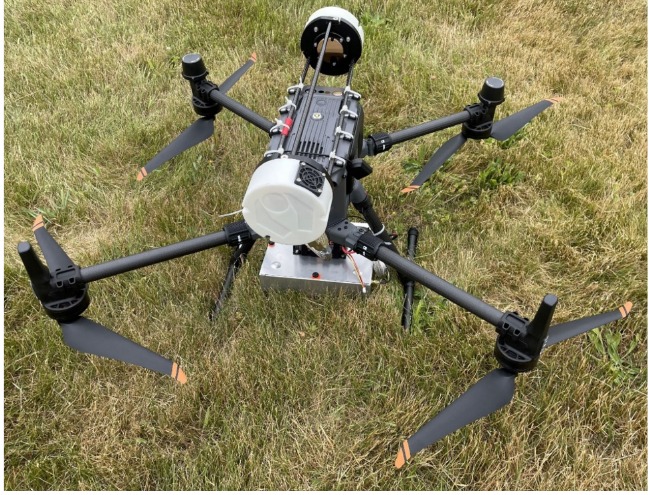
UAV agriculture spectroscopy sensor
Mid-infrared sensing can move onto UAVs and other mobile platforms to create geolocated field measurements.
FIELD + ENVIRONMENT

From individual plants to the atmosphere above the crop.

Agriculture operates across scales. Leaf-level diagnostics answer one question; spectroscopy can answer another by measuring gases, water or chemical signatures across fields, greenhouses and agricultural infrastructure.

The SMARTFARM program is the clearest example: a spectroscopy platform for measuring nitrous oxide and mapping where emissions occur rather than treating a field as one average value.

N₂ONH₃UAVOpen pathGreenhouseEnvironmental sensing
LIGHT + GROWTH

Use materials to manage the photons plants receive.

Controlled-environment agriculture turns light into a design variable. IMS can develop optical films and coatings around a partner's greenhouse, LED or solar architecture, with the goal of changing spectral distribution, scattering, uniformity or wavelength conversion.

Not a generic “grow film.”
Design the material around the crop and light source.

Start with the incoming spectrum, crop, canopy geometry and desired optical behavior. Then select host, dopants, particle size, morphology, concentration and film architecture. Candidate systems can be screened for conversion efficiency, angular distribution, durability, haze and compatibility with the customer's polymer or glass.

MORE AGRICULTURE OPPORTUNITIES

The platform expands well beyond two products.

These are best presented as development areas rather than as finished IMS products. Each one can draw from diagnostics, spectroscopy, optical materials or machine-readable identification depending on the problem.

01 · SOIL + NUTRIENTS

Soil chemistry and nutrient sensing

Optical and spectroscopic systems can target moisture, organic matter and selected chemical signatures. Specific N/P/K measurements require application-specific sensing chemistry or calibrated spectroscopy rather than a universal crystal response.

DEVELOPMENT AREA
02 · WATER

Irrigation + water quality

Cartridge assays, spectroscopy and optical sensors can be designed for irrigation, hydroponics, aquaculture and runoff monitoring. Targets may include nutrients, biological contamination and other analytes selected for the application.

DEVELOPMENT AREA
03 · CROP SENSING

Stress, canopy and harvest intelligence

Drone, tractor and fixed-camera spectroscopy can measure reflectance or fluorescence changes associated with crop condition, supporting stress mapping, canopy analysis, crop classification and harvest decisions.

SPECTRAL PLATFORM
04 · CONTROLLED ENVIRONMENT

Greenhouse + vertical farming

Combine light-management films, environmental sensors and crop diagnostics into a closed-loop system for greenhouses and vertical farms.

MULTI-PLATFORM
05 · POST-HARVEST

Storage, packaging + traceability

Optical sensing can support freshness or environmental indicators, while Intelligent Material can provide persistent product identity, authentication and supply-chain information on produce packaging.

ADJACENT PLATFORM
06 · ROBOTICS

Machine vision + navigation

Spectral data can help robots inspect crops, while machine-readable Intelligent Material markers can provide robust physical reference points for greenhouse fixtures, trays, rows and autonomous equipment.

INTEGRATION AREA
RESEARCH FRONTIERS

Ideas worth testing, without overstating what is proven.

SEED / PLANT INTERACTION

Track materials through the plant environment.

Optically identifiable particles could be explored as research tracers in soil, seed coatings or plant-uptake studies. Uptake, transport, persistence and biological compatibility would need to be experimentally established before any agricultural use claim.

SMART PACKAGING

Let the package carry both condition and identity.

Future produce packaging can combine authentication with optical indicators for temperature, humidity, ripening or contamination, using the sensing mechanism appropriate to the target.

AGRICULTURE

Bring us the agricultural problem. We will choose the optical platform.

Plant assay, greenhouse film, field spectrometer, water sensor or machine-readable infrastructure: the useful question is not “where can we put a crystal?” It is “what physical information or energy conversion does the system need?”

Discuss an agriculture application →