Put intelligence inside the game.
Intelligent Material can give toys, garments, play surfaces and collectibles an optical identity or behavior without turning every object into an electronic device.
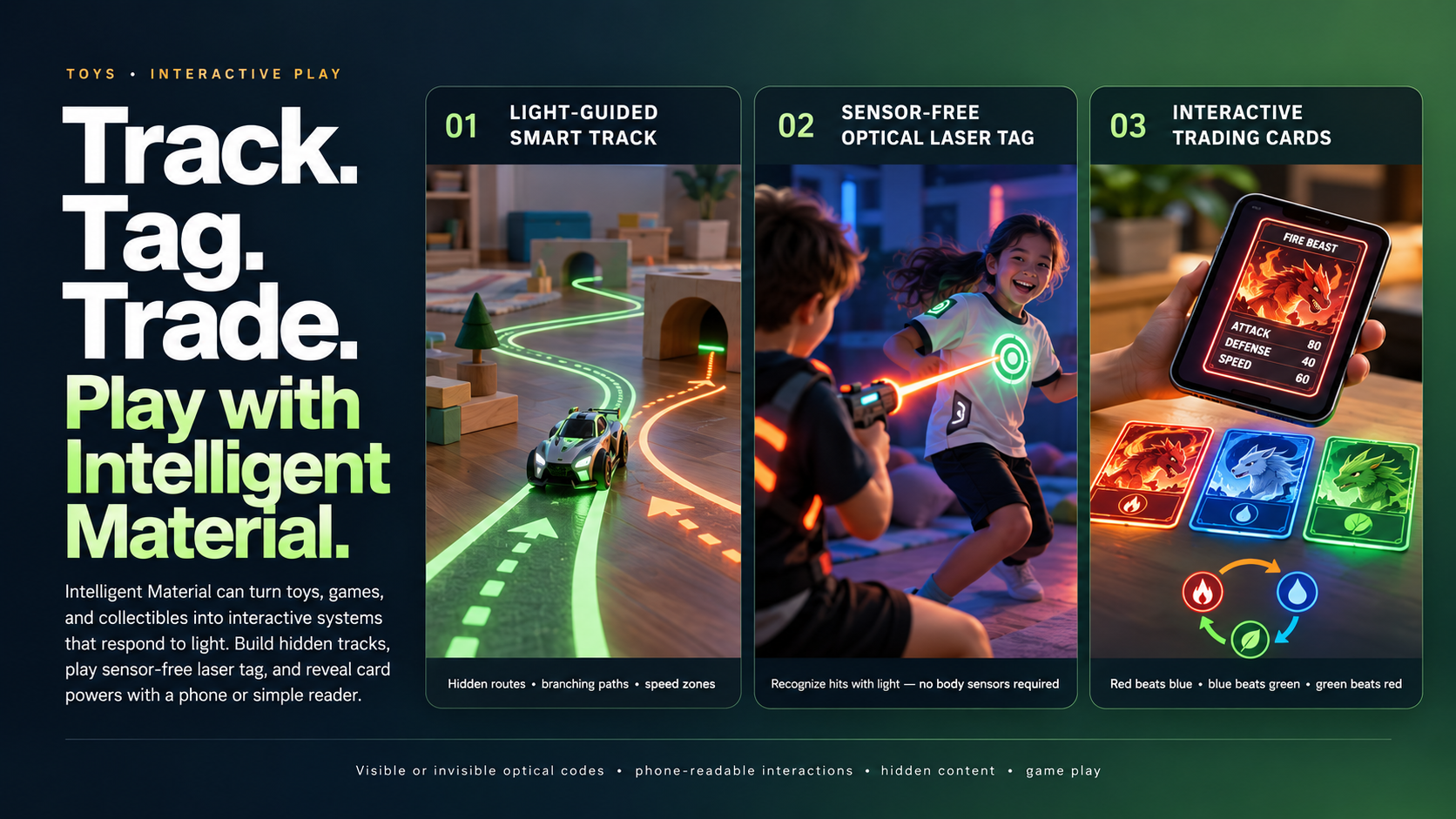
Start with play mechanics people understand instantly.
The strongest first concepts remain the trackless vehicle, sensor-free laser tag and interactive trading card. Each shows the same platform principle in a different way: the physical object carries information that can be read with light.
A track without rails.
Print or place an Intelligent Material route on a mat, table or floor. An optical reader under the car, train or robot follows the material instead of a physical rail.
Different material signatures can turn the surface into a command layer: route, speed, stop, reverse, branch, pit lane, scoring zone or special-event trigger.
Put the target into the shirt.
Intelligent Material can be printed, coated or incorporated into garments so the game system reads the optical response of the material itself.
The material can distinguish teams, players, hit zones or special armor without bulky sensor packs clipped to the body.
The card does more than sit in a deck.
Embed Intelligent Material into inks, coatings or card features. A phone or compact optical reader can identify hidden classes, powers, rarity and authenticating signatures.
Your simple battle mechanic stays front and center: red beats blue, blue beats green, green beats red. The material class can be part of both game play and authenticity.
Connect the physical toy to a digital world.
An optical identity can do more than prove authenticity. It can unlock a character, level, digital badge, ownership record or limited-edition experience.
That creates a direct version of the IMS mission: connect the physical world with the digital world, using the material itself as part of the bridge.
Build and paint with light in three dimensions.
Transparent blocks, gels or volumes containing Intelligent Material can illuminate internally where the optical excitation is delivered.
For toys, the idea becomes tangible: glowing construction blocks, puzzle cubes with hidden internal symbols, volumetric nightlights or “paint with light” play systems.
Give soft toys an optical personality.
Intelligent Material can be incorporated into fibers, embroidery, printed fabrics or coatings, creating plush toys, costumes and soft goods with hidden patterns or optical identities.
The material might define a team, character, special ability or collectible signature without requiring electronics inside every soft object.
Guidance. Identity. Reveal. Interaction.
A toy company does not need to buy one fixed “special effect.” IMS can engineer optical behavior around the product and the game mechanic.
The surface carries instructions.
Vehicles and robots read the play environment directly.
The object carries its own code.
Players, toys and collectibles can be optically distinguished without visible electronics.
Light unlocks a second visual layer.
Invisible excitation reveals clues, colors, patterns and hidden content.
The physical object changes the digital game.
Optical identity can become an app input, ownership key or game state.
Keep the strongest ideas visible without turning the page into a grab bag.
Education already has its own page, so Toys links to it rather than repeating the full STEM story. Several other ideas are worth exploring but should be presented as development concepts that may require additional sensing chemistry or matrices.
Start with the game behavior you want.
IMS can tune composition, particle size, excitation wavelength, emission color, lifetime, power response and integration method around the toy company's manufacturing process and reader architecture.
Engineer the optical response.
Choose the host, activator chemistry, size and morphology to target a particular excitation and emission behavior.
Put it where the game needs it.
Printing, coating, molding, plastics, fibers, fabrics, inks and collectible features can each require a different formulation.
Design the interrogation around the material.
Phone-based, handheld, toy-integrated or fixed readers can use wavelength, intensity and temporal response as identifying dimensions.
Turn physics into play.
The optical response becomes a route, class, identity, hidden state, power, unlock or collectible attribute.
The toy can be simple. The material can carry the intelligence.
IMS can develop custom optical game mechanics, Intelligent Material formulations and reader concepts for toys, collectibles, garments and interactive play surfaces.
Build a concept →