Read the
molecule itself.
This work is intentionally separate from the Intelligent Material crystal platform. No optical taggant is required. Tunable mid-infrared light interrogates the sample directly, and the molecule's own absorption spectrum becomes the information.
Not a crystal application.
That distinction matters. Intelligent Material uses engineered rare-earth crystals whose optical response is deliberately designed. Spectroscopy works differently: a QCL or ICL is tuned through wavelengths absorbed by the molecule of interest. An infrared detector measures the missing light. The molecule is the signature.
Laser → sample → detector → molecular fingerprint.
The architecture can be compact, portable and modular. The core is a tunable semiconductor laser, an optical path through or across the sample, a sensitive infrared detector and software that turns absorption into concentration or identity.
QCL / ICL source
A narrowband tunable mid-IR source sweeps across selected molecular absorption features. The patent expressly contemplates quantum cascade and interband cascade lasers.
Sample interaction
Gas can be measured in a cell or across an open path. Liquid and solid samples can be interrogated through ATR and related optical interfaces.
MCT detection
HgCdTe (MCT) detectors provide fast, sensitive detection over the mid-infrared bands used for molecular spectroscopy.
DAS / WMS analysis
Direct absorption and wavelength-modulation spectroscopy convert the detected optical signal into a calibrated molecular measurement.
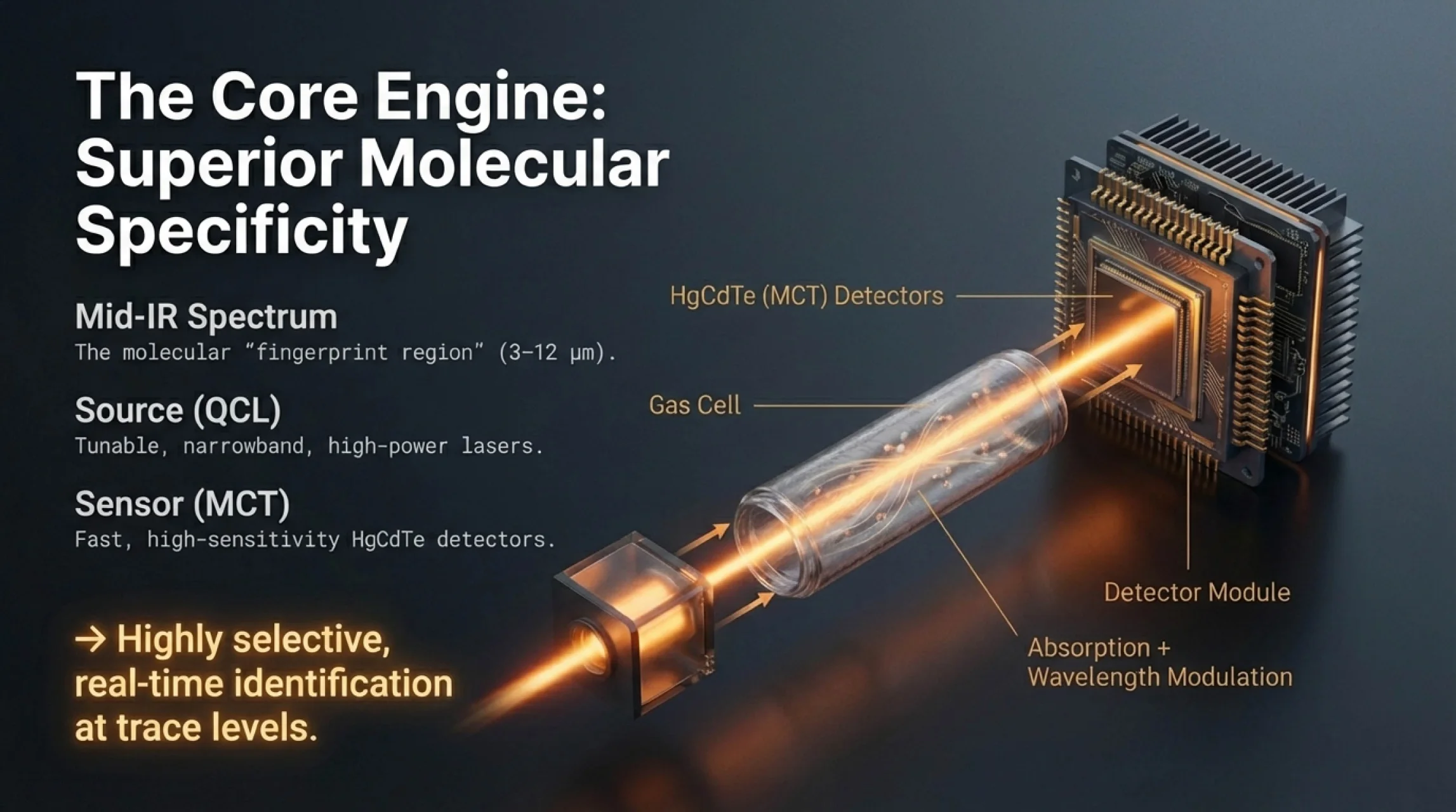
The molecular fingerprint region.
Many molecules have strong and highly specific absorption features in the mid-infrared. By tuning across those features, the system can move beyond simply detecting that “something is there” toward identifying and quantifying a particular species.
Our program materials focus heavily on the roughly 3–12 µm region, while detector architectures can cover a broader mid-IR range depending on the application.
One building. Three complementary capabilities.
The spectroscopy effort combines semiconductor photonics and detector hardware from SRI, optical sensing science and field expertise from Princeton University, and system architecture, IP development and commercialization work from IMS / NovaVera.
Lasers + detectors
SRI's Princeton team develops and fabricates infrared hardware. The worked example in US 11,953,434 identifies an SRI-manufactured QCL and an SRI-manufactured HgCdTe detector, both at 201 Washington Road.
Spectroscopy + field science
Professor Mark Zondlo's group develops optical sensors for trace gases, greenhouse gases and air pollutants, including compact QCL-based open-path instruments for field and UAV measurements.
Architecture + applications
IMS / NovaVera connects the optical engine to defense, industrial, environmental and medical programs, develops IP and system concepts, and drives translation toward deployable products.
Put the optical engine where it makes sense.
Not every measurement belongs in a sample cell. Mid-IR spectroscopy can also interrogate an atmospheric path, plume or perimeter, allowing the path itself to become the sample.
Distributed sensing without powered edge nodes.
One current concept uses a centralized QCL/MCT optical engine and passive retroreflectors. The beam crosses the region of interest, returns to the detector, and the spectral absorption accumulated along the path is analyzed at the hub.
This architecture is being explored for persistent perimeter and wide-area chemical / biological sensing because the active electronics stay centralized while passive reflectors define multiple optical paths.
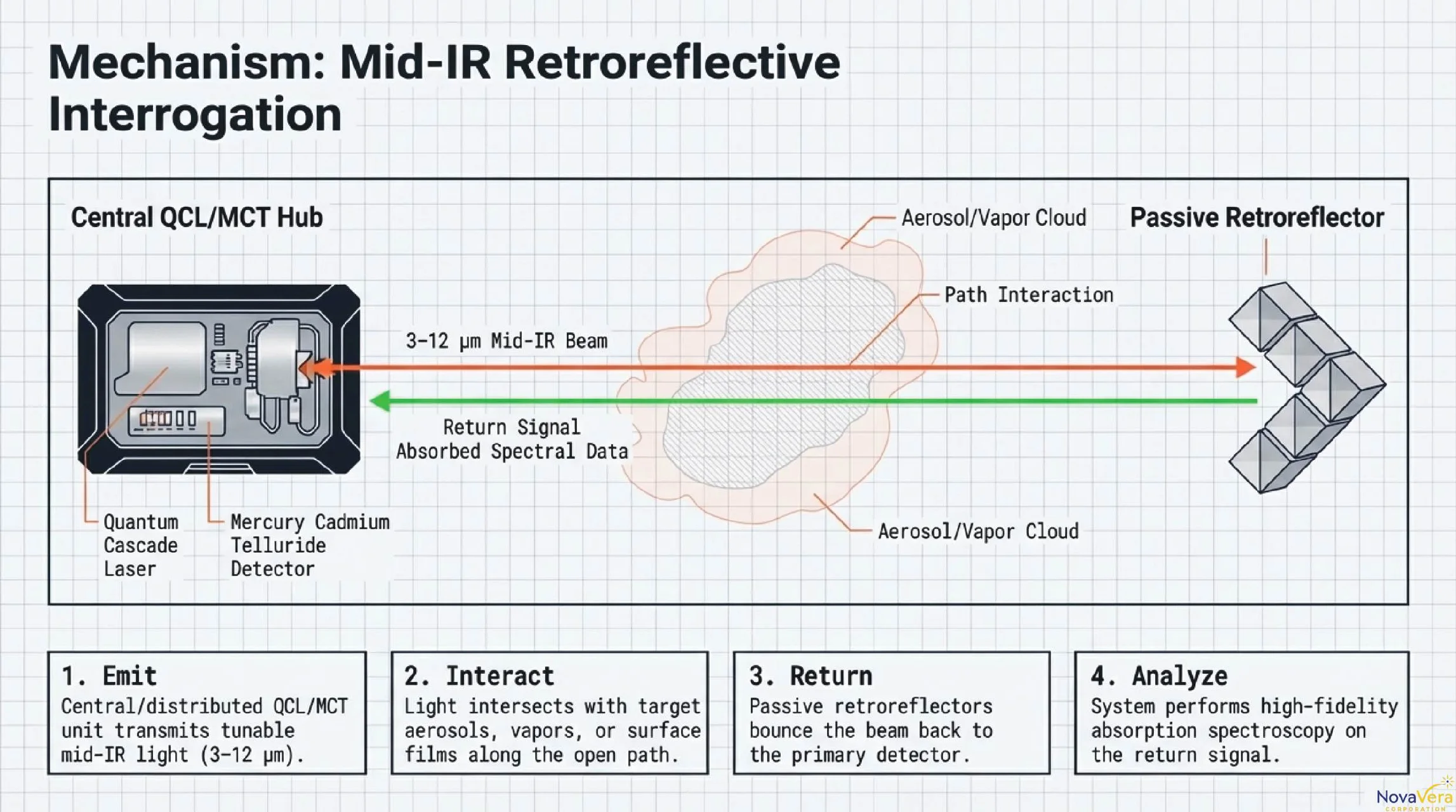
The same optical engine can interrogate very different samples.
The instrument changes by wavelength, optical path, sample interface and software. That makes spectroscopy a platform technology in its own right, independent of Intelligent Material crystals.
Greenhouse gases
Open-path and mobile sensing for N₂O, methane, ammonia, CO and related atmospheric species, including agricultural and emissions monitoring.
Gas purity + process control
Trace moisture, hydrogen purity, semiconductor gases, process streams and other situations where small contaminants matter.
Molecular threat identification
Mid-IR signatures for toxic industrial chemicals, chemical threats and other hazardous molecular species, with fixed, mobile and stand-off architectures.
Breath + liquid analysis
Research concepts include breath/headspace analysis and ATR-based interrogation of blood, plasma, urine and other clinical samples.

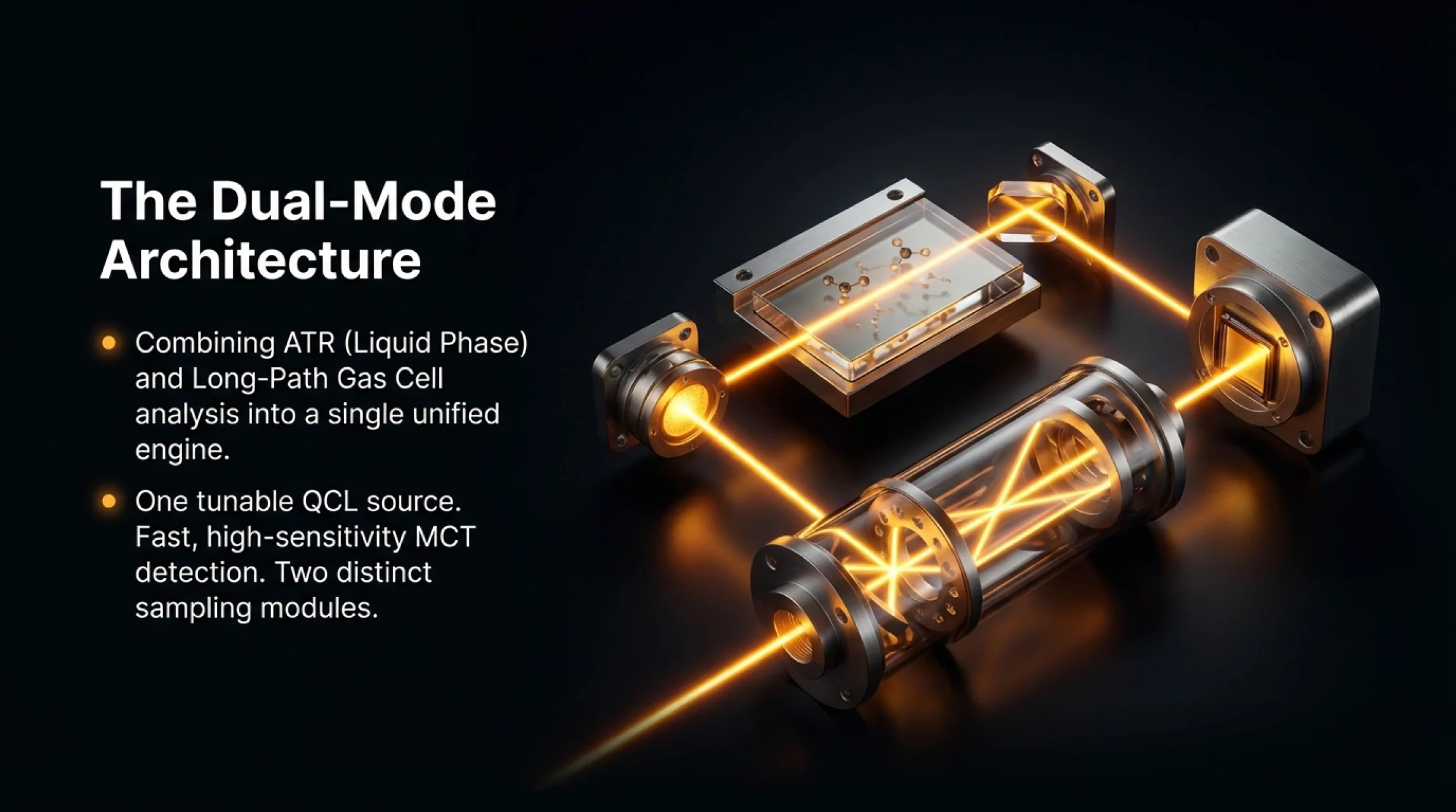
Read molecular chemistry directly.
Mid-infrared spectroscopy accesses strong molecular vibrational fingerprints. A tunable QCL or ICL source, sensitive MCT detection, carefully engineered sample handling and signal processing can form a flexible research platform for breath, headspace, liquid and tissue measurements.
QCL / ICL
Narrow-line, tunable mid-IR illumination selected around the molecular bands of interest.
Gas · liquid · tissue
Multi-pass cells, ATR interfaces, microfluidics or reflectance geometries put the photons where the chemistry is.
MCT / HgCdTe
Fast mid-IR detection measures wavelength-dependent absorption and converts it into a molecular fingerprint.
Spectral intelligence
Calibration, pattern recognition and longitudinal comparison turn spectra into quantitative research data.
Breath diagnostics research
Exhaled breath contains gases and volatile organic compounds that can be interrogated directly in the mid-IR. The platform can be configured around selected molecular bands rather than relying on a single broad sensor.
- Acetone and metabolic markers
- Nitric oxide and airway research
- Ammonia and other trace gases
- Multi-analyte VOC pattern studies
Urine + headspace
Headspace analysis offers a non-contact route to volatile metabolites while liquid interfaces can probe stronger nonvolatile chemistry. Controlled temperature, humidity and path length become part of the measurement architecture.
- VOC and metabolic fingerprint studies
- Drug / metabolite research
- Infection-related spectral patterns
- Point-of-care architecture development
Blood + serum
ATR and microfluidic geometries can interrogate microliter-scale liquid samples. Water is a major mid-IR absorber, so path length, wavelength selection and calibration are central engineering problems rather than afterthoughts.
- Glucose, lactate, urea and lipid research
- Drug-level and formulation studies
- Protein / amide spectral changes
- Flow-through and cartridge concepts
Tissue + surfaces
Reflectance, ATR and imaging configurations can investigate tissue composition and spatial chemistry. Potential research directions include spectral histopathology, wound characterization and margin-assessment studies.
- Tissue classification
- Spectral imaging
- Surface / wound characterization
- Research on surgical or biopsy margins
More than a laser and detector.
The core spectroscopy engine can operate independently of Intelligent Material crystals. Where useful, IMS can also engineer optical materials, coatings and sample interfaces around the instrument to improve photon handling, sample interaction and multi-modal readout.
Breath analyzer
Tunable source, controlled gas cell, MCT detector and spectral-analysis software in a dedicated breath-sampling instrument.
Multi-sample analyzer
A common optical engine with swappable gas, ATR and transmission interfaces for biomarker discovery, pharma work and assay development.
Cartridge platform
Compact source and detector architecture paired with disposable microfluidic sample handling for future clinical translation.
A spectroscopy patent built around deployable molecular sensing.
This patent is separate from the Intelligent Material crystal patent family. It is about spectroscopic hardware, calibration, sample handling and molecular measurement.
Spectroscopic devices, systems, and methods for optical sensing of molecular species
The patent covers portable spectroscopic systems for measuring molecular species in gas, liquid or solid samples. It describes QCL or ICL light sources, infrared detection, reference-gas calibration, direct absorption spectroscopy, wavelength-modulation spectroscopy, open- and closed-path measurements, and ATR interfaces.
Howard Bell and Josh Collins are among the named inventors alongside Princeton's Mark Zondlo, Lei Tao, Da Pan and Paul Guiguizian, with additional Shell inventors. Google Patents lists Princeton University and Shell entities as current assignees.
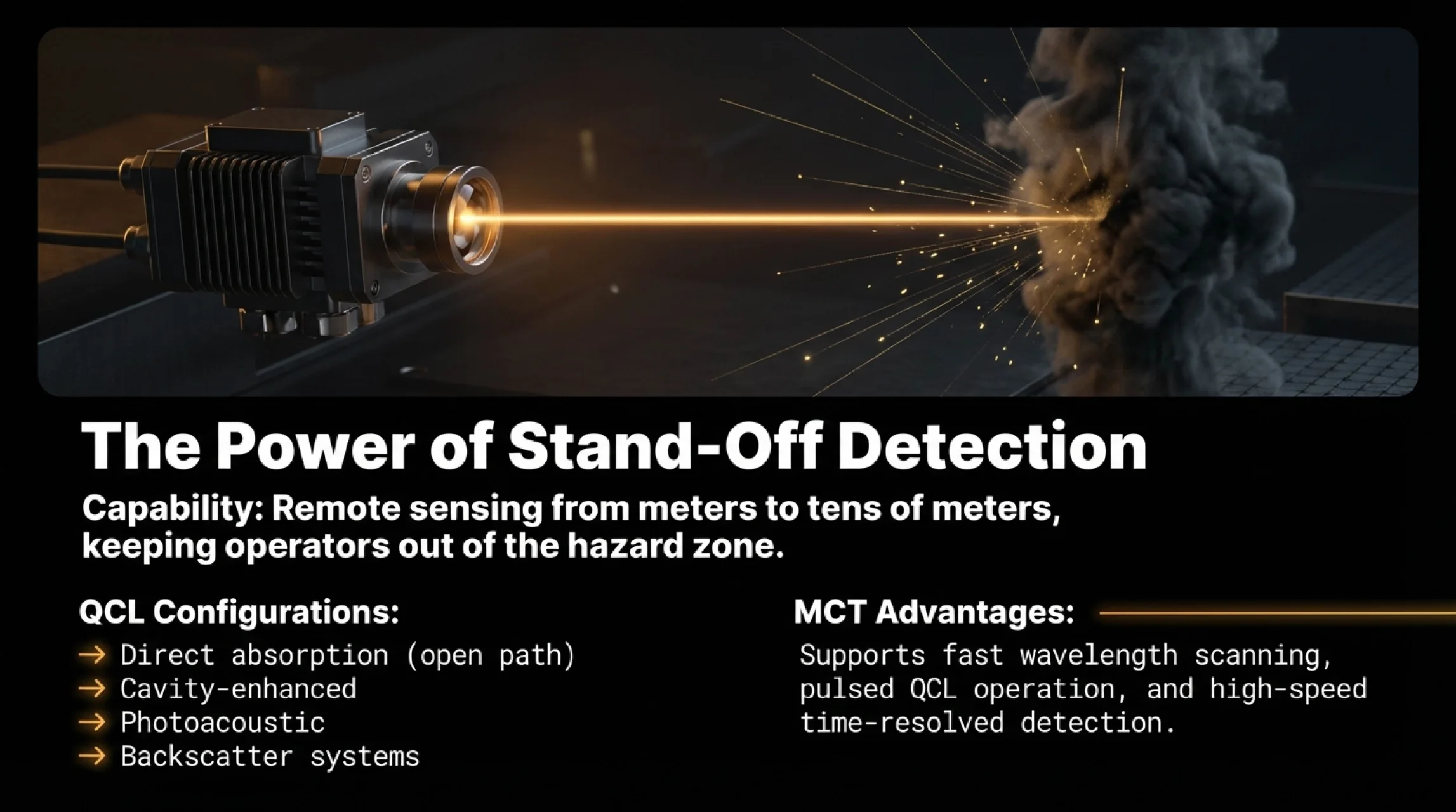
From the lab bench to the field.
Mid-infrared spectroscopy becomes especially valuable when molecular specificity can be carried into compact, rugged hardware. Tunable sources, fast detectors, calibration architecture and signal processing are the pieces that make that transition possible.
The current program spans fixed infrastructure, portable systems, mobile platforms and networked sensing concepts rather than a single instrument.
The molecule already contains the information. We build the optical system that reads it.
For spectroscopy programs, IMS / NovaVera works with SRI and Princeton to combine source, detector, optical architecture and application-specific sensing.